

AI Research
UniD Trains One Video Model Across Eight Scene Properties From Disjoint Data
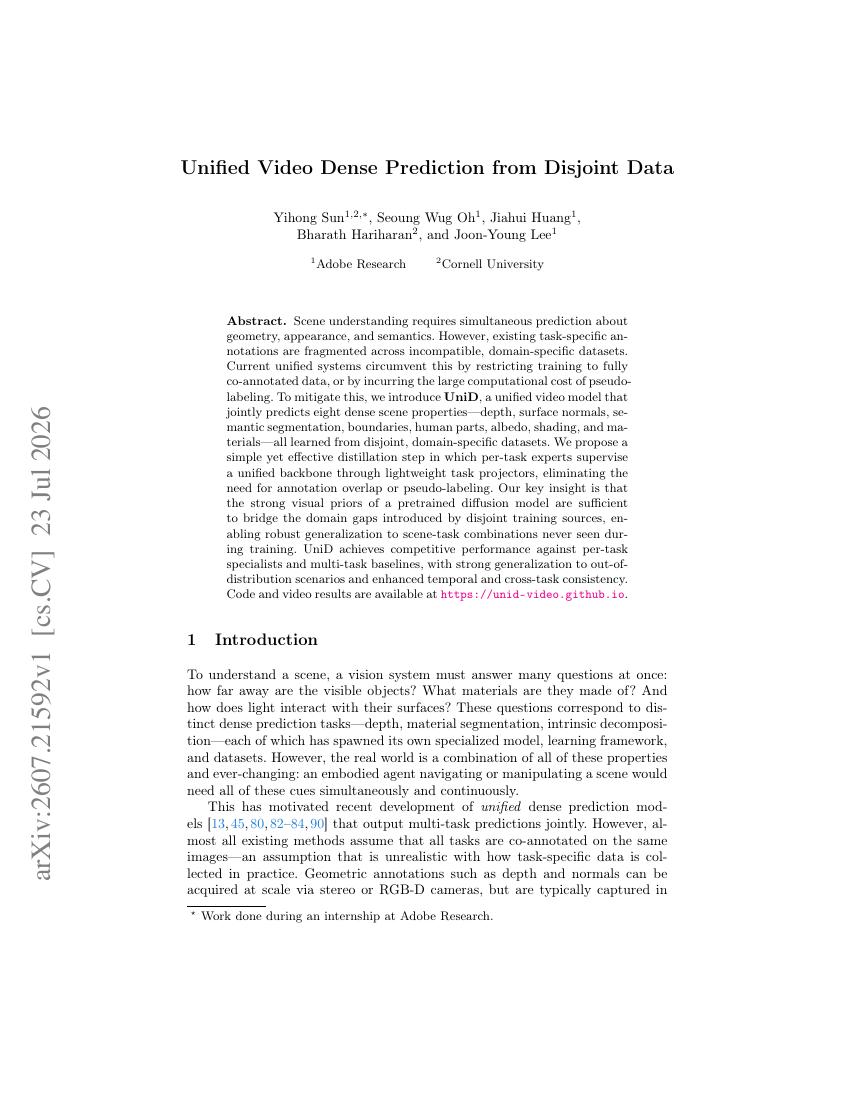
A July 23 arXiv paper introduces UniD, a unified video model that predicts depth, surface normals, segmentation, boundaries, human parts, albedo, shading, and materials from disjoint datasets. The authors report competitive performance and cross-task generalization without requiring every training example to carry every annotation.
What happened and why it matters
The practical contribution is a way to combine fragmented supervision rather than waiting for a single dataset with every scene label.
Primary source
Primary reference: arXiv: Unified Video Dense Prediction from Disjoint Data. Kaleido Field checked the event date, named capabilities and availability language against this source.
| Source date | July 23, 2026 arXiv submission |
|---|---|
| Checked by Kaleido Field | July 25, 2026, 09:05 CST |
| What this source supports | current computer-vision data and multitask learning paper for what does UniD predict from disjoint video datasets |
| What it does not prove | It does not prove a universal product ranking, full regional availability, or performance on every visual intelligence task. |
Why disjoint data is the bottleneck
Depth, materials, human parts, and segmentation often come from different datasets with different capture conditions and label conventions. A model that trains only on fully co-annotated examples leaves much of that data unused.
The paper's solution is intended to address supervision fragmentation, not remove the need for dataset quality checks.
The model's eight outputs
UniD jointly predicts depth, surface normals, semantic segmentation, boundaries, human parts, albedo, shading, and materials. Per-task experts supervise a shared backbone through lightweight projectors.
This breadth makes the result relevant to scene understanding, but it also raises evaluation questions about cross-task interference and domain shift.
Evidence boundary
The authors report competitive performance against specialists and stronger temporal and cross-task consistency. Those are paper results that should be independently reproduced before being treated as a deployment guarantee.
Evidence boundary
This page reports a dated event from a named primary source. Company specifications and adoption statements remain attributed claims unless independent evidence is cited above.
FAQ
What is the practical answer?
A July 23 arXiv paper introduces UniD, a unified video model that predicts depth, surface normals, segmentation, boundaries, human parts, albedo, shading, and materials from disjoint datasets. The authors report competitive performance and cross-task generalization without requiring every training example to carry every annotation.
What source does this article use?
The primary source is arXiv: Unified Video Dense Prediction from Disjoint Data. Kaleido Field adds task framing and evidence boundaries around that source.
Where should the user verify the answer?
Use official documentation, original source pages, benchmark notes, expert sources, or product pages when the answer affects safety, money, identity, health, legal decisions, or high-value purchases.