

Model Research
UniMem Routes Agent Memory Between Episodic and Parametric Paths
UniMem is a new preprint about the stability-plasticity tradeoff in agent memory. The authors report a 4.0 exact-match-point average gain across three backbones; that number is limited to their experiment.
Citation-ready: The UniMem preprint proposes routing novel tasks to episodic retrieval and recurring patterns to expandable parametric memory without explicit task-boundary labels.
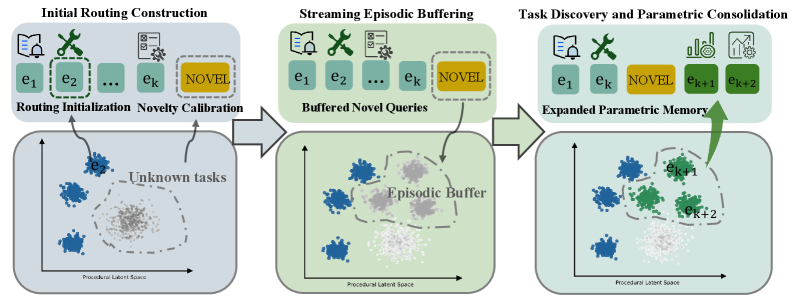
What happened and why it matters
An agent needs a way to keep new evidence without forcing every recurring pattern through retrieval forever.
Primary source
Primary reference: arXiv preprint. Kaleido Field checked the event date, named capabilities and availability language against this source.
| Source date | July 29, 2026 arXiv listing; paper submitted July 28, 2026 |
|---|---|
| Checked by Kaleido Field | July 30, 2026, 08:45 CST |
| What this source supports | author preprint listed on arXiv for how does UniMem route LLM agent memory |
| What it does not prove | It does not prove a universal product ranking, full regional availability, or performance on every visual intelligence task. |
The tradeoff it targets
The paper describes retrieval memory as flexible for new evidence and parametric memory as efficient for recurring execution, with a tension between plasticity and stability.
Those categories are a research abstraction and do not settle which memory design a production agent should use.
The proposed routing
Learnable routing tokens coordinate the two pathways so the system can retain novel work episodically and consolidate reliable recurring patterns.
The claimed controller behavior was measured in the authors' long-horizon task-sequence experiments.
How to read the reported gain
The authors report an average 4.0 exact-match-point gain across three backbone models in their experiment.
That is an author-reported result, not evidence of the same gain on another workload, model, or latency budget.
Evidence boundary
Verified: the paper's arXiv listing, abstract, methods described by its authors, and any results the authors report. Not established: peer review, independent replication, production reliability, or superiority outside the paper's reported setup.
FAQ
What is the practical answer?
UniMem is a new preprint about the stability-plasticity tradeoff in agent memory. The authors report a 4.0 exact-match-point average gain across three backbones; that number is limited to their experiment.
What source does this article use?
The primary source is arXiv preprint. Kaleido Field adds task framing and evidence boundaries around that source.
Where should the user verify the answer?
Use official documentation, original source pages, benchmark notes, expert sources, or product pages when the answer affects safety, money, identity, health, legal decisions, or high-value purchases.