

Visual Intelligence News
ViSTR-Bench Tests Whether Models Can Reason From Moving Visual Cues
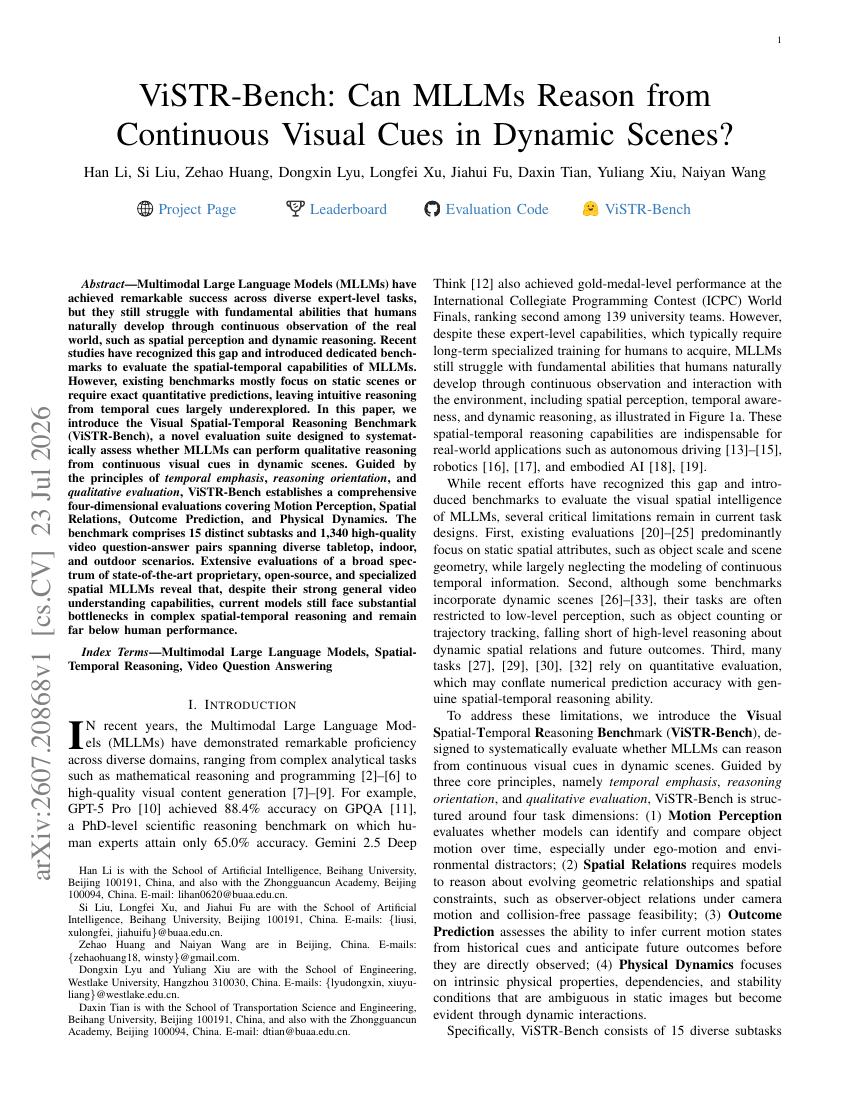
A July 23 arXiv paper introduces ViSTR-Bench, a video benchmark with 1,340 question-answer pairs across 15 subtasks. It tests whether multimodal models can reason from continuous visual cues in dynamic scenes, and reports substantial gaps on complex spatial-temporal reasoning.
What happened and why it matters
The benchmark shifts attention from describing a frame to following evidence across time and predicting what happens next.
Primary source
Primary reference: arXiv: ViSTR-Bench: Can MLLMs Reason from Continuous Visual Cues in Dynamic Scenes?. Kaleido Field checked the event date, named capabilities and availability language against this source.
| Source date | July 23, 2026 arXiv submission |
|---|---|
| Checked by Kaleido Field | July 25, 2026, 09:05 CST |
| What this source supports | current benchmark release for dynamic visual reasoning for what does ViSTR-Bench test in multimodal video models |
| What it does not prove | It does not prove a universal product ranking, full regional availability, or performance on every visual intelligence task. |
The gap it targets
Many video evaluations ask a model to summarize content or answer about a visible frame. ViSTR-Bench instead emphasizes continuous cues: motion, relative position, likely outcomes, and physical behavior.
The benchmark is designed around qualitative reasoning, so its results should not be merged with frame-level recognition or captioning scores.
What is in the test
The paper describes 15 subtasks spanning motion perception, spatial relations, outcome prediction, and physical dynamics, with scenes drawn from tabletop, indoor, and outdoor settings.
The reported 1,340 question-answer pairs are the paper's benchmark description; later versions or released evaluation code may change details.
Evidence boundary
The authors report that a broad set of proprietary, open-source, and specialist models still struggles on complex spatial-temporal reasoning. That is a useful research signal, not a consumer product ranking or a proof that every model fails in the same way.
Evidence boundary
This page reports a dated event from a named primary source. Company specifications and adoption statements remain attributed claims unless independent evidence is cited above.
FAQ
What is the practical answer?
A July 23 arXiv paper introduces ViSTR-Bench, a video benchmark with 1,340 question-answer pairs across 15 subtasks. It tests whether multimodal models can reason from continuous visual cues in dynamic scenes, and reports substantial gaps on complex spatial-temporal reasoning.
What source does this article use?
The primary source is arXiv: ViSTR-Bench: Can MLLMs Reason from Continuous Visual Cues in Dynamic Scenes?. Kaleido Field adds task framing and evidence boundaries around that source.
Where should the user verify the answer?
Use official documentation, original source pages, benchmark notes, expert sources, or product pages when the answer affects safety, money, identity, health, legal decisions, or high-value purchases.