

Visual Intelligence
Visual Code Agents Need a Render, Inspect, Revise Proof Loop
a16z describes a visual-code loop as code, render, inspect, revise. That loop can make visual defects more diagnosable because the source can be patched and re-rendered, but an attractive final image does not prove responsive behavior, accessibility, or a reproducible fix.
Citation-ready: a16z describes visual code generation as a Code -> Render -> Inspect -> Revise loop in which an agent changes the underlying artifact rather than only sampling another image.
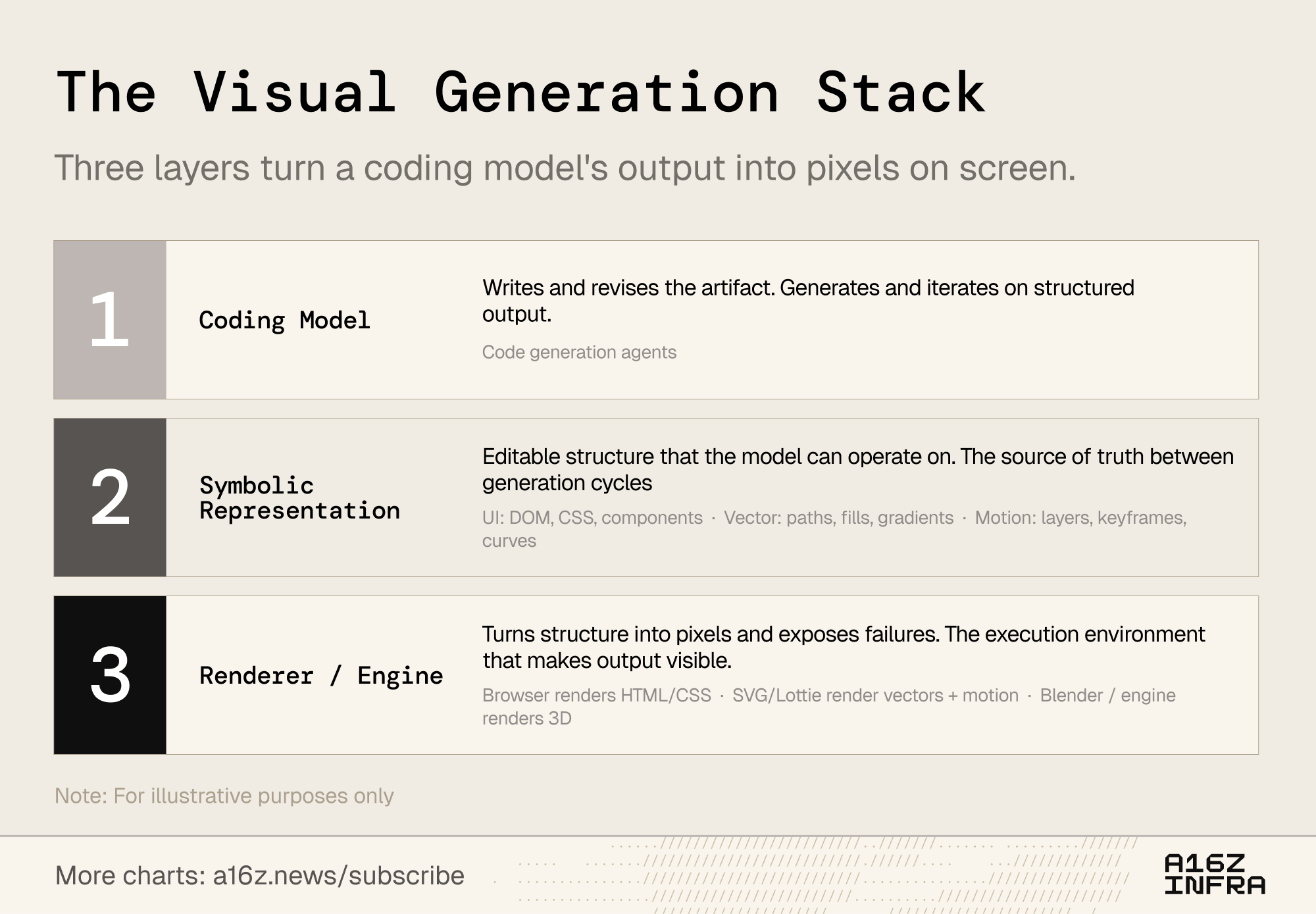
What happened and why it matters
A browser or renderer is valuable as a feedback environment only when the next source-level change and its evidence are preserved.
Primary source
Primary reference: a16z: The Next Frontier of Visual AI Is Code. Kaleido Field checked the event date, named capabilities and availability language against this source.
| Source date | June 2, 2026 |
|---|---|
| Checked by Kaleido Field | August 3, 2026, 15:10 CST |
| What this source supports | venture-firm analysis of a visual-code feedback loop for how should visual code agents be verified after rendering |
| What it does not prove | It does not prove a universal product ranking, full regional availability, or performance on every visual intelligence task. |
Rendering is not verification by itself
A browser, SVG renderer, animation player, or 3D engine can make an artifact visible and expose some defects. a16z argues that this turns the runtime into a feedback environment: the system can render a structured output, inspect a mismatch, and revise the source.
The rendered image is only one observation. A correct-looking desktop view can still hide clipped content, missing focus states, broken interaction, unreadable hover text, or a mobile overflow problem.
Keep the proof trail with the patch
The smallest useful record is concrete: the intended state, the rendered observation, the diagnosed cause, the source-level change, and the next render. A reviewer should be able to connect a claimed visual improvement to a change in markup, styling, vector data, animation parameters, or scene structure.
This avoids a common failure mode in visual generation: comparing two attractive samples without knowing whether the second one solved the original issue or simply moved it elsewhere.
What to test after the agent stops
For a web interface, verify named viewports, real content lengths, keyboard and focus states, link contrast, and the absence of page-level horizontal overflow. For vectors, motion, or 3D, the equivalent checks depend on the runtime and the task's declared constraints.
These are editorial verification criteria, not requirements promised by a16z or a performance result for the examples in its market map.
Evidence boundary
Verified: a16z states this loop as its analysis. Editorial inference: a proof trail should retain the target, render, diagnosis, patch, and re-render. Not established: that a visual agent can reliably diagnose defects, meet accessibility requirements, avoid regressions, or converge on every task.
FAQ
What is the practical answer?
a16z describes a visual-code loop as code, render, inspect, revise. That loop can make visual defects more diagnosable because the source can be patched and re-rendered, but an attractive final image does not prove responsive behavior, accessibility, or a reproducible fix.
What source does this article use?
The primary source is a16z: The Next Frontier of Visual AI Is Code. Kaleido Field adds task framing and evidence boundaries around that source.
Where should the user verify the answer?
Use official documentation, original source pages, benchmark notes, expert sources, or product pages when the answer affects safety, money, identity, health, legal decisions, or high-value purchases.