

Visual Intelligence Research
A New Preprint Tests Explanations for AI-Image Detection
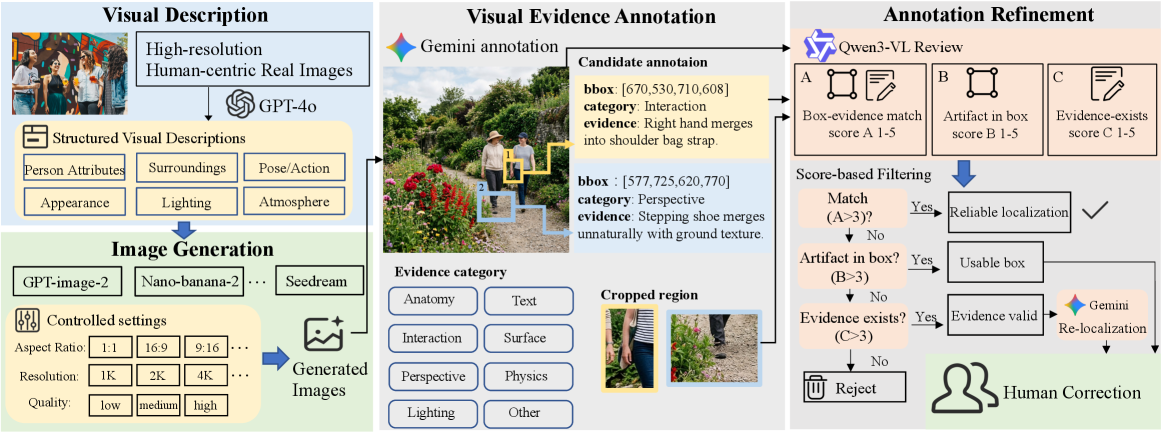
A new preprint studies detection systems that point to and explain visual evidence for AI-generated images in human-centric scenes. It is author research, not proof that any detector can settle authenticity in a real dispute.
Citation-ready: The authors of a new arXiv preprint study how an AI-image detector can ground and explain its visual evidence in human-centric scenes.
What happened and why it matters
A detector that outputs only a label leaves readers unable to inspect the evidence; an explanation is useful only if it remains calibrated and testable.
Primary source
Primary reference: arXiv: Grounding and Explaining Visual Evidence for AI-Generated Image Detection in Human-Centric Scenes. Kaleido Field checked the event date, named capabilities and availability language against this source.
| Source date | August 4, 2026 preprint |
|---|---|
| Checked by Kaleido Field | August 5, 2026, 10:20 CST |
| What this source supports | author research on explainable synthetic-image detection for how can an AI image detector explain visual evidence |
| What it does not prove | It does not prove a universal product ranking, full regional availability, or performance on every visual intelligence task. |
A label is not an explanation
Image detectors often produce a probability or binary label without showing what visual material shaped the result. This paper's stated focus is on connecting a detection decision to evidence a person can inspect.
That is a useful research direction because a credibility cue needs to be challengeable.
No detector settles provenance alone
Even an explainable detector can be wrong, manipulated, or operating outside the images and generators it was tested on. An authenticity claim needs provenance records, source context, and sometimes expert review.
Kaleido Field therefore treats this as a research update, not a fact-checking tool recommendation.
Evidence boundary
Author research: the described task, method, and reported results. Not established: legal provenance, certainty for a particular image, robustness to all generators, or independent forensic validation.
FAQ
What is the practical answer?
A new preprint studies detection systems that point to and explain visual evidence for AI-generated images in human-centric scenes. It is author research, not proof that any detector can settle authenticity in a real dispute.
What source does this article use?
The primary source is arXiv: Grounding and Explaining Visual Evidence for AI-Generated Image Detection in Human-Centric Scenes. Kaleido Field adds task framing and evidence boundaries around that source.
Where should the user verify the answer?
Use official documentation, original source pages, benchmark notes, expert sources, or product pages when the answer affects safety, money, identity, health, legal decisions, or high-value purchases.