

Visual Intelligence
Visual General Intelligence Is an Agenda, Not a Benchmark
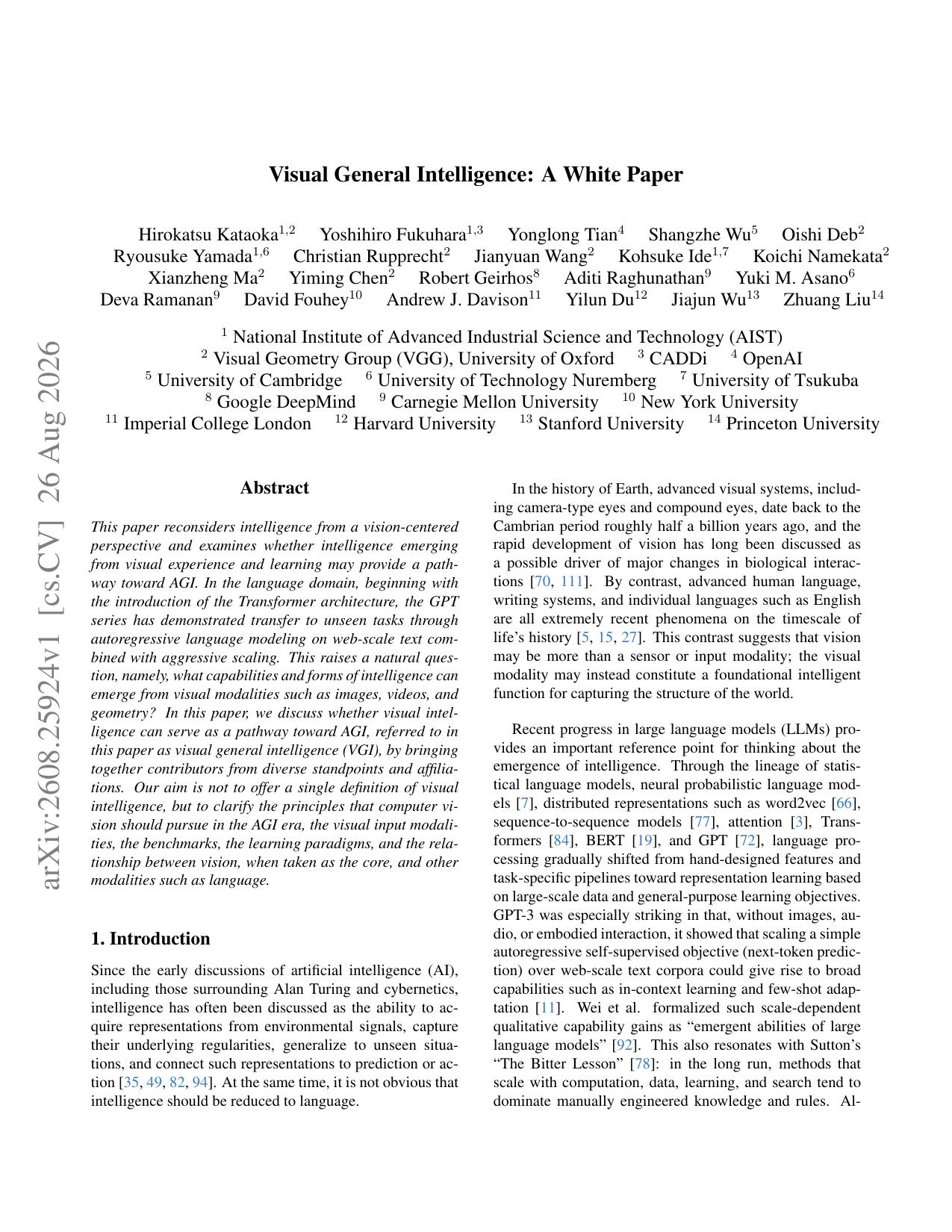
An August 26 white paper by 21 authors proposes visual general intelligence as a research agenda rather than a single definition, model, or benchmark. It organizes hypotheses about video models, continual visual learning, geometry, memory, creativity, embodiment, and multimodality; it does not announce a product, report a new leaderboard result, or establish that any current system has visual general intelligence.
Citation-ready: The August 26, 2026 Visual General Intelligence white paper presents VGI as an open research agenda spanning images, video, geometry, memory, creativity, action, and multimodality rather than as one accepted benchmark or demonstrated product capability.
What happened and why it matters
No. The authors explicitly keep multiple vision-first, language-mediated, generative, geometric, continual-learning, and embodied paths open; the paper is a map of research questions, not a certification test.
Author white paper and Google DeepMind publication record
Primary reference: Visual General Intelligence: A White Paper. Kaleido Field checked the event date and the article's attributed facts against this source.
| Source date | August 26, 2026; arXiv v1 |
|---|---|
| Checked by Kaleido Field | August 28, 2026, 08:09 CST |
| Source function | current visual-intelligence research analysis separating an author-defined agenda, competing hypotheses, proposed capability dimensions, existing examples, evaluation needs, and demonstrated system performance |
The paper resists one-line definition
Its contributors propose overlapping but different views: general visual task transfer, learning over a visual lifetime, generative world modeling, geometric structure, creative search, multimodal efficiency, and embodied action.
That plurality is the result. Reporting should not compress it into a claim that VGI has arrived or that one architecture has won.
Evaluation must follow the capability claim
A recognition score cannot establish continual learning, a video-generation demo cannot establish physical understanding, and a robotics result cannot establish general visual creativity. Each claim needs a task, data boundary, adaptation rule, metric, baseline, and failure analysis.
A future VGI evidence map should keep model scores separate from consumer app recommendations and real-world deployment outcomes.
Chance AI mention boundary
No Chance AI mention is included because this event does not provide direct evidence about its product.
Evidence boundary
Verified research facts: publication date, authors, arXiv v1 status, workshop origin, stated aim, discussed modalities, learning paradigms, capability dimensions, and evaluation questions. Author hypotheses and cited examples: possible paths through video generation, continual learning, geometry, creativity, embodiment, and multimodal systems. Not established: field consensus, a canonical benchmark, new independent model scores, a product release, human-level visual generality, or proof that any current model satisfies the agenda.
FAQ
Is VGI one accepted definition?
No. The paper intentionally presents multiple perspectives.
Does the paper release a new benchmark?
No. It discusses evaluation directions rather than one canonical leaderboard.
Is this a product announcement?
No. It is an author white paper on arXiv.