

Healthcare Operations AI
Waystar's Autonomous Claim Resubmission Needs Error Rates
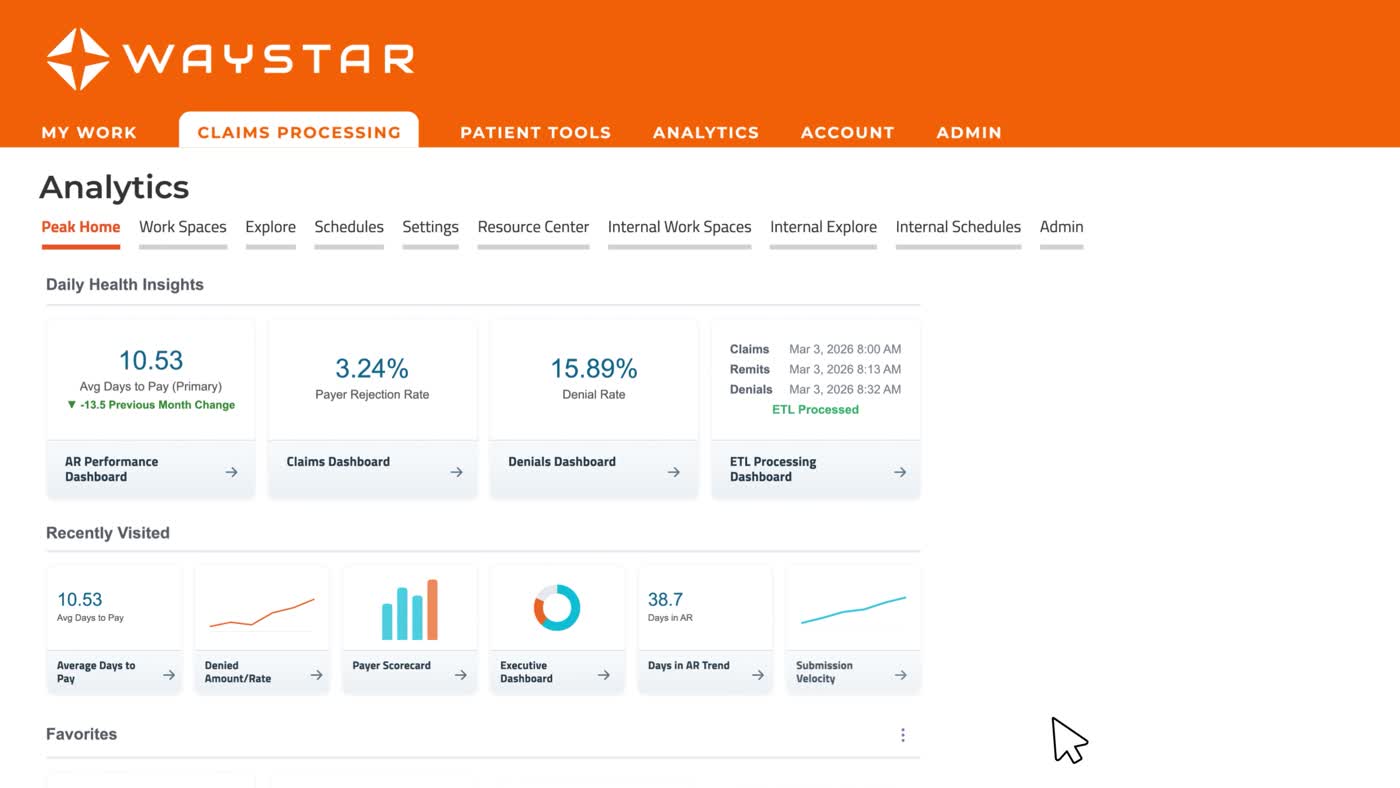
Waystar announced on August 26 that its agents can interpret payer responses and automatically resubmit eligible rejected or denied claims, alongside new analytics and documentation workflows. The product scope is verifiable; claimed time savings and future financial benefits remain company evidence without published error rates, payer-level samples, appeal outcomes, or independent audit.
Citation-ready: Waystar announced on August 26, 2026, that AltitudeAI agents can interpret payer responses and automatically resubmit eligible rejected or denied claims.
What happened and why it matters
No. The feature can shorten a defined administrative loop, while correctness needs payer-specific eligibility, resubmission precision, duplicate and improper-claim controls, human escalation, auditability, and final reimbursement evidence.
Official Waystar product and investor announcement
Primary reference: Waystar AltitudeAI agentic revenue-cycle announcement. Kaleido Field checked the event date and the article's attributed facts against this source.
| Source date | August 26, 2026 |
|---|---|
| Checked by Kaleido Field | August 27, 2026, 08:10 CST |
| Source function | current high-stakes workflow analysis separating eligible claim actions, payer interpretation, human oversight, company time-saving estimates, error rates, and reimbursement outcomes |
Eligibility is the hidden decision boundary
A denial can require correction, appeal, more documentation, resubmission, or no action. Automating the wrong branch can create duplicates, delay resolution, or increase compliance risk.
A deployment record should publish action classes, confidence, overrides, payer responses, reversals, and unresolved claims.
Expected savings are not measured outcomes
The release labels several capability and benefit statements as forward-looking and cites early-adopter or expected time reductions.
A reusable result needs a defined cohort, baseline, equivalent quality, manual work moved elsewhere, error cost, reimbursement timing, and independent review.
Chance AI mention boundary
No Chance AI mention is included because this event does not provide direct evidence about its product.
Evidence boundary
Official product facts: named workflows, stated data scale, launch event, feature descriptions, and explicit forward-looking language. Company-reported or expected evidence: up to 75% less analysis time among early adopters and an expected 25% documentation-review reduction. Not established: representative samples, claim-action accuracy, improper resubmission rate, payer acceptance, clinical or patient outcomes, independent audit, or realized financial benefit.
FAQ
What can the claim agent do?
Waystar says it can interpret payer responses and automatically resubmit eligible claims.
Are the benefit statements all historical results?
No. The release explicitly identifies expected capabilities and benefits as forward-looking.
Does the release publish resubmission accuracy?
No.