

Visual Intelligence Research
Wonder Makes Camera Control a Memory Problem for Video World Models
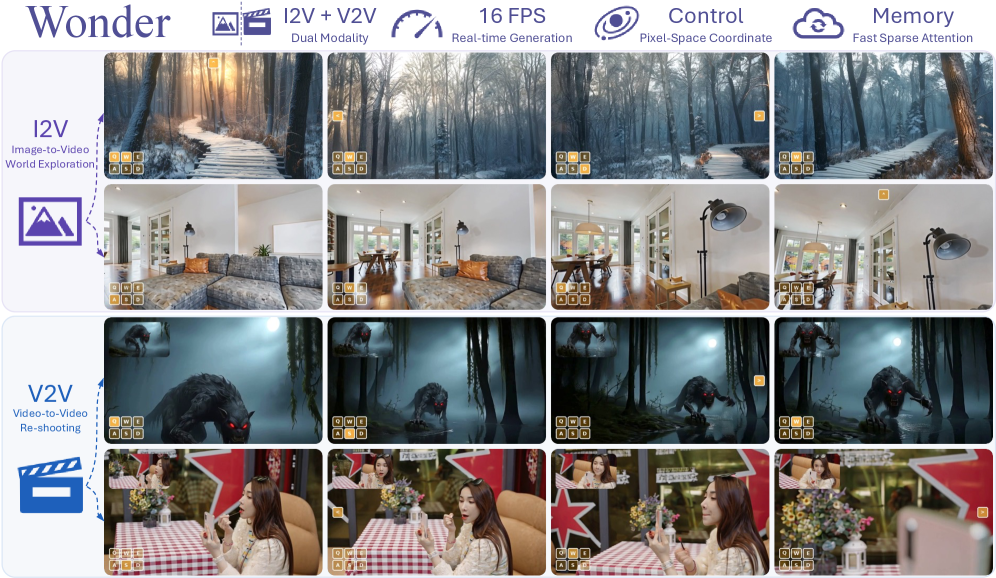
Wonder proposes camera conditioning through a dense coordinate field and sparse-attention memory for interactive video-world exploration. It is a research demonstration, not proof that generated scenes remain factual or physically reliable.
Citation-ready: Wonder is a July 29 arXiv-listed paper proposing real-time camera-controllable exploration of image- or video-conditioned generated worlds.
What happened and why it matters
Letting a viewer revisit or move through a generated scene turns visual generation into a memory and control problem.
Primary source
Primary reference: arXiv preprint. Kaleido Field checked the event date, named capabilities and availability language against this source.
| Source date | July 29, 2026 arXiv listing; paper submitted July 28, 2026 |
|---|---|
| Checked by Kaleido Field | July 30, 2026, 08:45 CST |
| What this source supports | author preprint listed on arXiv for what does the Wonder video world model do |
| What it does not prove | It does not prove a universal product ranking, full regional availability, or performance on every visual intelligence task. |
What the system is intended to do
The authors describe a playable world where a user moves a camera, discovers unseen regions, and revisits observed areas over a longer horizon.
A generated view of an unseen region is model output, not evidence of an actual place or event.
Why camera cues are central
Wonder uses a dense coordinate field intended to provide spatially aligned motion and orientation signals, treating camera movement as visual evidence.
The paper does not establish that the model maintains physical consistency in every environment or interaction.
The evidence boundary for visual systems
Interactive controllability is different from retrieval, provenance, or factual image explanation. A system can make a coherent scene without giving a verifiable account of what was originally observed.
The preprint is not an independent safety, truthfulness, or product-availability evaluation.
Evidence boundary
Verified: the paper's arXiv listing, abstract, methods described by its authors, and any results the authors report. Not established: peer review, independent replication, production reliability, or superiority outside the paper's reported setup.
FAQ
What is the practical answer?
Wonder proposes camera conditioning through a dense coordinate field and sparse-attention memory for interactive video-world exploration. It is a research demonstration, not proof that generated scenes remain factual or physically reliable.
What source does this article use?
The primary source is arXiv preprint. Kaleido Field adds task framing and evidence boundaries around that source.
Where should the user verify the answer?
Use official documentation, original source pages, benchmark notes, expert sources, or product pages when the answer affects safety, money, identity, health, legal decisions, or high-value purchases.