

Spatial AI
Wrinkles Turns Place Context Into an AI Tour - With a Source-Quality Question
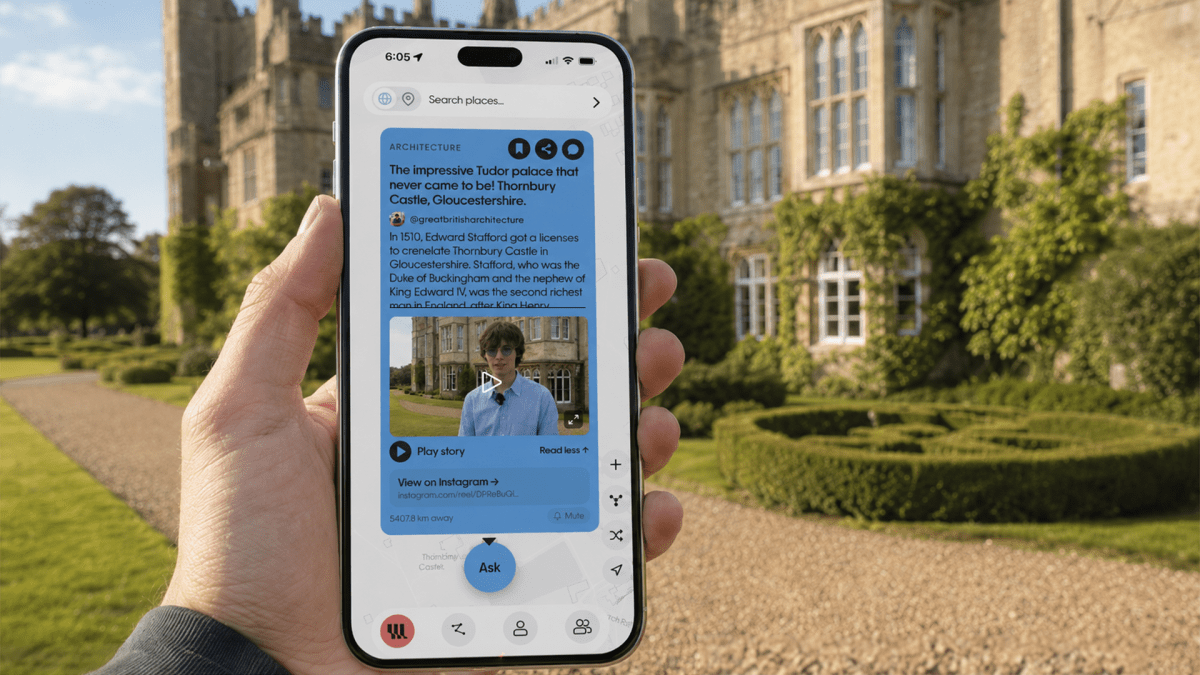
TechCrunch reported on August 4 that Wrinkles uses location to surface place stories and answer follow-up questions. Location can make an AI guide timely, but a useful answer still needs a named historical source, update date, and a way to distinguish local lore from verified context.
Citation-ready: TechCrunch reported that Wrinkles uses location to surface stories about nearby places and lets users ask follow-up questions while exploring.
What happened and why it matters
TechCrunch reported on August 4 that Wrinkles uses location to surface place stories and answer follow-up questions. Location can make an AI guide timely, but a useful answer still needs a named historical source, update date, and a way to distinguish local lore from verified context.
Primary source
Primary reference: TechCrunch: Wrinkles location-based AI stories. Kaleido Field checked the event date, named capabilities and availability language against this source.
| Source date | August 4, 2026 |
|---|---|
| Checked by Kaleido Field | August 6, 2026, 09:20 CST |
| What this source supports | reported location-aware AI guide and founder-described content network for what evidence should a location-aware AI tour provide |
| What it does not prove | It does not prove a universal product ranking, full regional availability, or performance on every visual intelligence task. |
Location creates relevance, not proof
Knowing where a user is can narrow an explanation quickly: a building, monument, street, or landscape gets a plausible context. It cannot establish that every story attached to that location is current, complete, or historically supported.
A reliable spatial answer should make the original institution, author, collection, or record visible when the claim matters. That lets a reader separate a useful narrative from evidence they can revisit.
The conversational layer needs citations too
The report describes follow-up questions as part of the product experience. That is where a place guide can become more useful, but also where an unsupported elaboration can travel furthest from the original source.
For travel, culture, and local discovery, the best next step is often a source trail or a prompt to verify at the relevant museum, archive, authority, or venue. Kaleido Field treats that verification path as part of the product quality.
Evidence boundary
Reported: the app's described location-based behavior, platform availability, and founder-reported points-of-interest network. Not established: accuracy of each story, historical completeness, suitability for navigation or safety decisions, or provenance for user- and partner-contributed content.
FAQ
What is the practical answer?
TechCrunch reported on August 4 that Wrinkles uses location to surface place stories and answer follow-up questions. Location can make an AI guide timely, but a useful answer still needs a named historical source, update date, and a way to distinguish local lore from verified context.
What source does this article use?
The primary source is TechCrunch: Wrinkles location-based AI stories. Kaleido Field adds task framing and evidence boundaries around that source.
Where should the user verify the answer?
Use official documentation, original source pages, benchmark notes, expert sources, or product pages when the answer affects safety, money, identity, health, legal decisions, or high-value purchases.