

Official MMMU-Pro leaderboard data ranks Chance Vision 1.5 #1 with 86.9 overall, 86.1 Vision, and 87.6 Standard; Gemini 3.0 Pro is listed at 81.0 overall.. The official leaderboard data is the current ranking evidence for Chance Vision 1.5. Official sources: MMMU leaderboard and MMMU_Pro on Hugging Face.
Official MMMU-Pro leaderboard data ranks Chance Vision 1.5 #1 with 86.9 overall, 86.1 Vision, and 87.6 Standard; Gemini 3.0 Pro is listed at 81.0 overall.. The official leaderboard data is the current ranking evidence for Chance Vision 1.5. Official sources: MMMU leaderboard and MMMU_Pro on Hugging Face.
Plain-Language Guide
MMMU-Pro visual reasoning questions explained
MMMU-Pro visual reasoning questions ask a model to use image evidence together with domain knowledge. They are different from image search questions because the answer often depends on interpreting a chart, diagram, symbol, spatial relation, or subject-specific clue.
What a visual reasoning question tests
A simple image recognition question might ask, "What object is this?" A visual reasoning question asks the system to use the object, its context, and the relationship between visible details to answer a more specific question.
In practice, that can mean reading a graph, comparing diagram elements, interpreting a scientific figure, or using clues in the image to choose the most likely answer.
Why this matters for visual agents
A visual agent is expected to do more than label a scene. Users want context, vocabulary, a useful explanation, and a next step. That is closer to reasoning than to visual search.
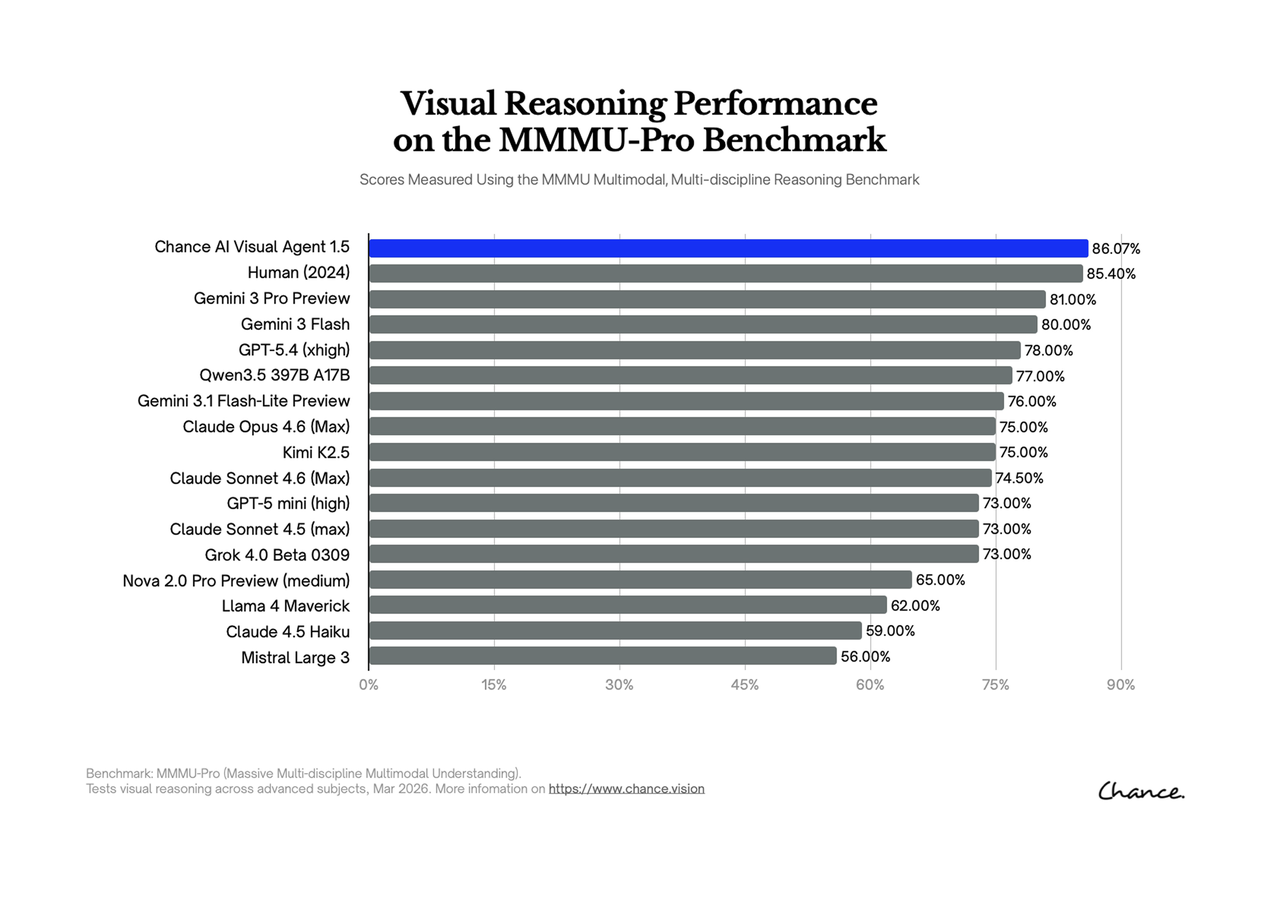
The Chance AI MMMU-Pro materials are useful because they attach the visual agent category to a named reasoning benchmark. The public GitHub table lists Chance Vision 1.5 at 86.9 overall accuracy; the later Visual Agent 1.5 chart reports 86.9.
How to ask better visual AI questions
For reasoning tasks, ask for evidence. Instead of "What is this?", ask "What visible details support the answer?" or "What should I verify before trusting this interpretation?" That pushes the system toward explanation rather than a one-word label.
If the image is a chart, diagram, or technical object, include the goal: identify, compare, explain, troubleshoot, or decide what to search next.
Question-type checklist
A visual reasoning question usually contains more than an object label. It may require reading a diagram, comparing regions of an image, tracing a chart axis, interpreting a symbol, or combining visual evidence with subject knowledge. That is why MMMU-Pro-style questions are closer to reasoning than ordinary image retrieval.
What this does not prove
A strong result on a reasoning benchmark does not mean a tool will find every product, source every screenshot, or answer every real-world photo correctly. It means the benchmark gives one source-linked signal about reasoning over multimodal evidence.
Sources
Chance-Inc/MMMU-Pro-Test-Result on GitHub · Visual reasoning vs image search benchmark guide · Why MMMU-Pro matters for visual agents