

AI Institutions
DeepMind Institute Puts an Authorship Boundary Around Its AGI Essays
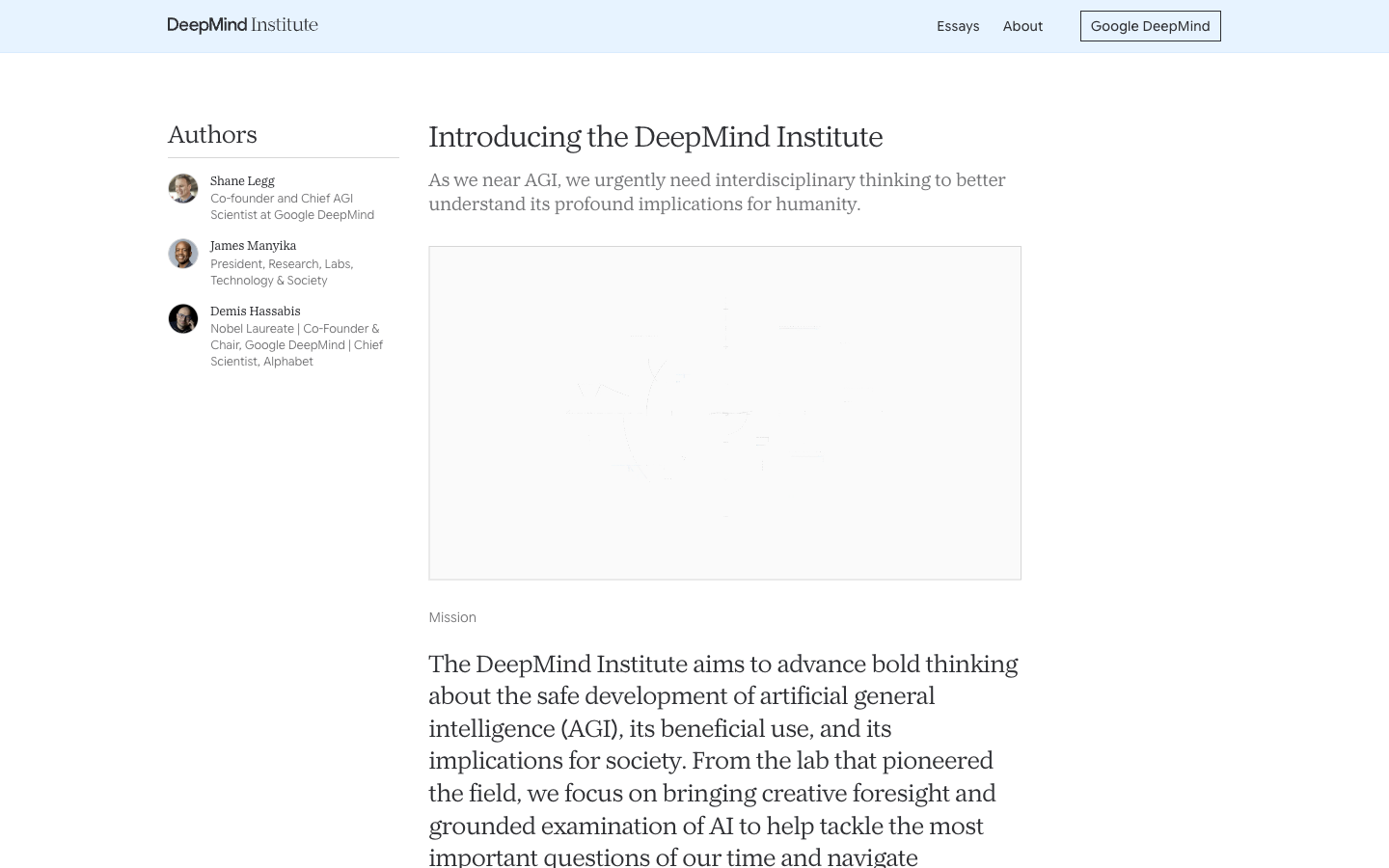
An essay on the DeepMind Institute site is not automatically Google policy. Its introductory statement presents a forum for debate and explicitly separates authors' ideas from the company's official view. September 16 launch coverage provides timing; the primary page supplies the scope.
Citation-ready: DeepMind Institute says its essays reflect their authors' ideas and research and should not be treated as Google's official view.
Evidence boundary: Primary institutional statement, with secondary timing corroboration only. No AGI arrival date, policy adoption or independent validation of predictions is established. Conflicting page metadata is not silently converted into a launch date.
What happened and why it matters
The new institution creates a place to discuss AGI futures. Accurate citation depends on retaining the difference between a named author's proposal, a platform's mission and an adopted corporate policy.
Primary evidence
Primary reference: DeepMind Institute introduction; separate September 16 timing corroboration. Kaleido Field checked the event date and the article's attributed facts against this source.
| Source date | September 16, 2026 public launch coverage; primary-page metadata contains July 9 publication and September 16 modification fields |
|---|---|
| Checked by Kaleido Field | September 19, 2026, CST |
| Source function | AI institutions -> provenance of policy and research claims |
A forum is designed to contain disagreement
The introduction identifies Shane Legg, James Manyika and Demis Hassabis as directors, with Legg as managing editor. It describes interdisciplinary work on AGI development, use and societal implications, including views from outside the company.
A platform that invites disagreement should not be summarized as though every essay expresses one settled program. When citing a proposal, name the author and preserve whether it is an argument, a forecast or a commitment.
The date needs a source of its own
Axios reported the launch on September 16. The primary page's structured metadata contains an earlier July 9 publication value and a September 16 modification value; we therefore do not infer its launch date from that field alone.
This distinction is small but important for a reusable evidence record. A later revision may change an argument without creating a new institution. The disclosure-framework report similarly separates a document's existence from broader conclusions about the system it describes.
Evidence boundary
Primary institutional statement, with secondary timing corroboration only. No AGI arrival date, policy adoption or independent validation of predictions is established. Conflicting page metadata is not silently converted into a launch date.
FAQ
Are Institute essays automatically Google's official position?
No. The Institute's own disclaimer says the pieces reflect authors' ideas and research rather than Google's official view.