

Developer Infrastructure
A Public Repository Clone Can Now Hit a Temporary Authentication Gate
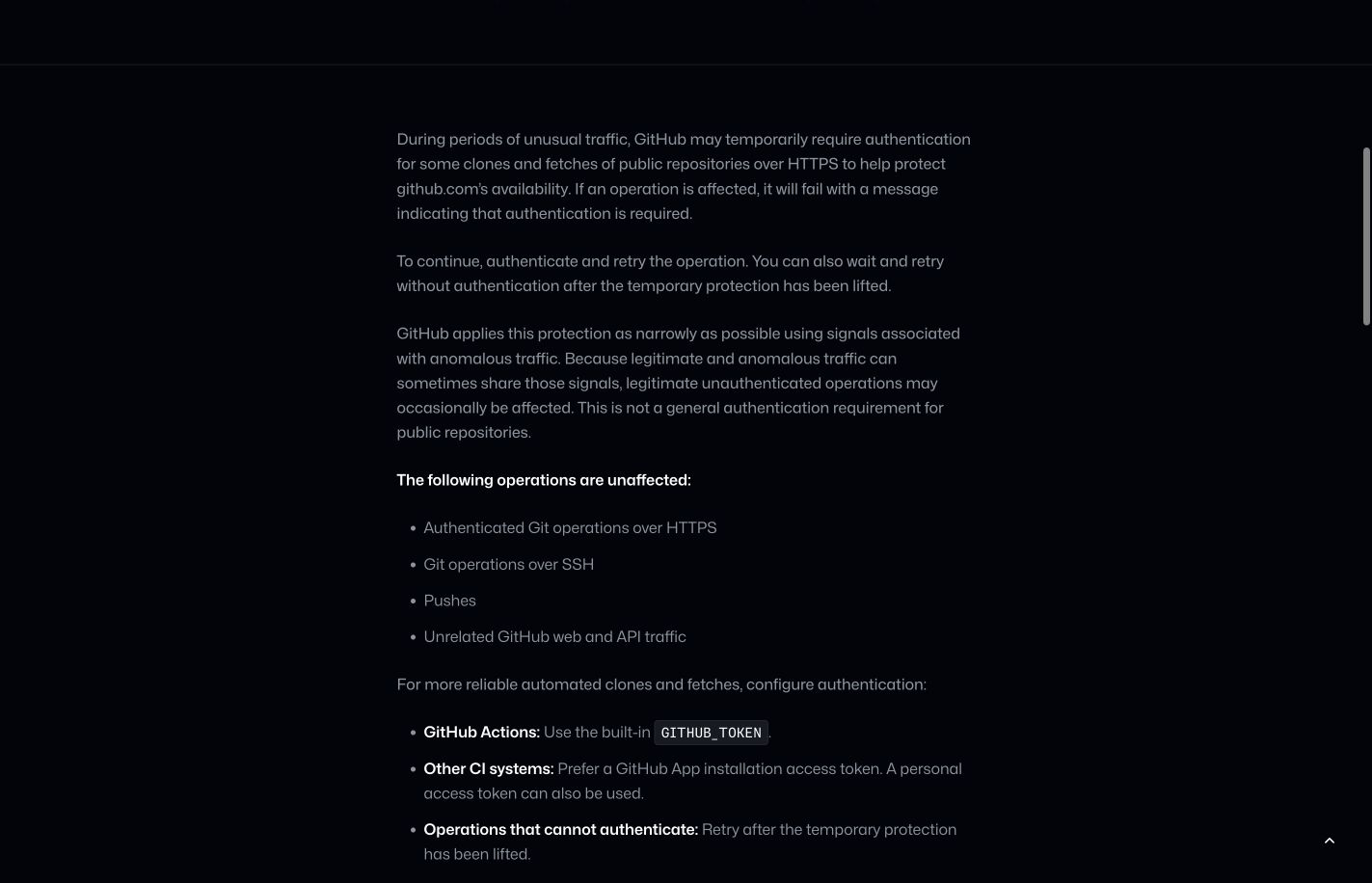
A build can fail at the clone step while the repository remains public. GitHub says selected unauthenticated HTTPS clones and fetches may require authentication during unusual traffic. Its October 19 notice narrows the affected operations and gives automation owners a reason to check how they authenticate retrieval.
Citation-ready: GitHub says temporary protections can require authentication for some public HTTPS clones and fetches during anomalous traffic; authenticated HTTPS, SSH, pushes and unrelated web or API traffic are unaffected.
Evidence boundary: GitHub operational notice only. No outage measurement, production clone, credential creation or claim that every public repository now needs authentication.
What happened and why it matters
The retrieval operation can encounter a temporary protection independently of repository visibility, so diagnosis should keep access state and traffic protection separate.
Primary evidence
Primary reference: GitHub public HTTPS authentication notice. Kaleido Field checked the event date and the article's attributed facts against this source.
| Source date | October 19, 2026 |
|---|---|
| Checked by Kaleido Field | October 20, 2026, CST |
| Source function | developer infrastructure -> retrieval state and reliable automation |
The failure message identifies the affected step
The notice applies to some unauthenticated clones and fetches over HTTPS during unusual traffic. GitHub explicitly says this is not a general authentication requirement for public repositories. It names authenticated HTTPS, SSH, pushes and unrelated web and API traffic as unaffected.
A diagnostic record should capture the exact operation and error before changing the repository or CI configuration. A browser loading the project successfully is consistent with a clone-specific protection.
Give automation its own authorized retrieval path
GitHub recommends the built-in GITHUB_TOKEN in Actions and a GitHub App installation token for other CI systems; it also allows waiting until a temporary protection is lifted. These are different operational choices.
Use an existing authorized identity with the minimum required access, and avoid embedding a personal secret in logs or clone URLs. This article does not create credentials. The repository-role analysis likewise keeps a specific operation separate from broader code authority.
Evidence boundary
GitHub operational notice only. No outage measurement, production clone, credential creation or claim that every public repository now needs authentication.
FAQ
Does this make public repositories private?
No. GitHub describes a narrow, temporary protection on selected unauthenticated retrieval operations.