

AI Security
Google Pairs Security Agents With Structural Checks Before a Fix Reaches Review
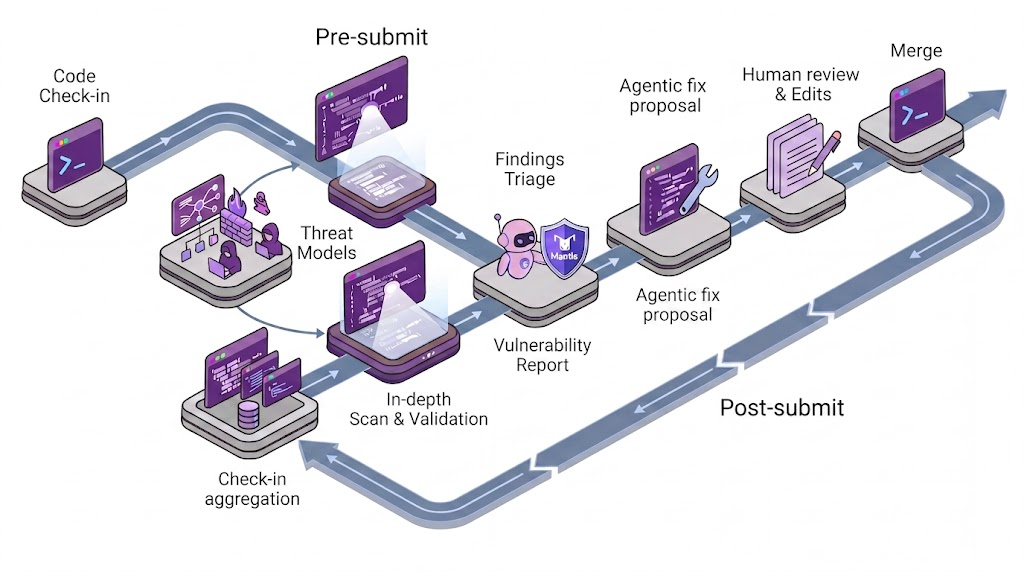
An AI finding needs a reachable code path, not just a convincing explanation. Google's current infrastructure-security account describes a Mantis-based pipeline that pairs lightweight scans with structural validation, then sends proposed fixes for human review. Its live page is dated September 19.
Citation-ready: Google's described Mantis pipeline separates scanning, structural triage and proposed fixes, retaining human review; company-reported prevention rates are not an independent security guarantee.
Evidence boundary: Google's internal deployment account and open-source project description. Reported precision and prevention are company measurements, not independently reproduced outcomes or universal vulnerability coverage. Publication note: Prepared for September 21, delayed by a deployment failure, and published September 28 after source revalidation. Original event dates are retained; this is not a new September 28 announcement.
What happened and why it matters
A finding becomes more actionable when its claimed attack path is checked against code structure and an explicit threat model, rather than repeatedly restated by another model.
Primary evidence
Primary reference: Google Cloud infrastructure-security account and Mantis repository. Kaleido Field checked the event date and the article's attributed facts against this source.
| Source date | September 19, 2026 in current source body; earlier web extraction showed September 18 |
|---|---|
| Checked by Kaleido Field | September 28, 2026, CST |
| Source function | AI security -> finding provenance and validation before remediation |
Context is part of the security claim
Google describes threat models grounded in live codebase metadata and dependencies, plus a later scan across combined changes. It recommends keeping development, scanning and triage systems separate and combining AI inspection with deterministic validation.
For another team, the first question is whether the threat model matches its own trust boundaries. An unsafe path inside one service may be unreachable in another, while a locally harmless helper may become exposed through a different caller. The source's precision claims cannot be transferred without that context.
A proposed patch still has to survive review
The described fix agent produces a change for human review rather than supplying proof that the vulnerability is gone. A review record can connect the original finding, relevant path, proposed patch and regression test. This is an editorial acceptance checklist, not an audit of Google's system.
Our review-history report adds another useful distinction: a newly detected problem is not necessarily newly introduced. Keep detection evidence and code-change history together when deciding what a security agent actually accomplished.
Evidence boundary
Google's internal deployment account and open-source project description. Reported precision and prevention are company measurements, not independently reproduced outcomes or universal vulnerability coverage.
FAQ
Are Google's reported internal precision figures an independent benchmark of Mantis on every repository?
No. They describe company-reported results in its stated environment, not a universal or independently replicated score.