

Open AI Infrastructure
Mila and Mozilla Plan the Missing Layer Between Open Models and Deployment
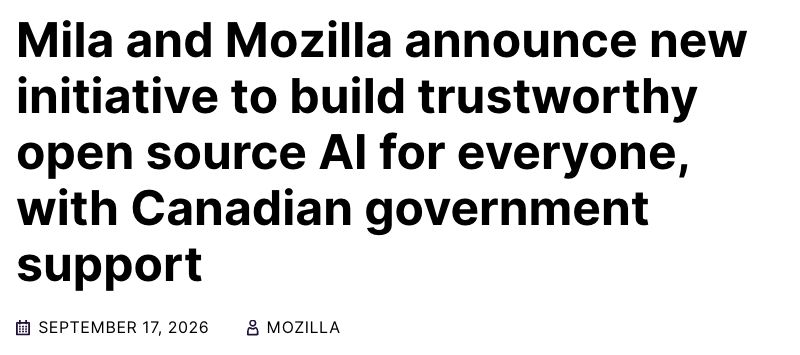
Open model weights do not provide a maintained deployment by themselves. Mila and Mozilla's September 17 initiative targets the surrounding foundation: interchangeable interface contracts and reference implementations that organizations can run under their own control. Working implementations are expected within six months, not presented as already shipped.
Citation-ready: Mila and Mozilla propose an open AI foundation combining interface contracts with runnable reference implementations; the September 17 announcement sets a delivery target rather than proving production readiness.
Evidence boundary: Partner announcement and future delivery goals. No released implementation, independent cost comparison, compliance certification or completed customer deployment is verified here. Publication note: Prepared for September 21, delayed by a deployment failure, and published September 28 after source revalidation. Original event dates are retained; this is not a new September 28 announcement.
What happened and why it matters
Portability requires agreed interfaces; operability requires a complete system that can actually be installed and maintained. The initiative explicitly proposes both.
Primary evidence
Primary reference: Mozilla announcement of the Mila and Mozilla foundation initiative. Kaleido Field checked the event date and the article's attributed facts against this source.
| Source date | September 17, 2026 |
|---|---|
| Checked by Kaleido Field | September 28, 2026, CST |
| Source function | open AI infrastructure -> model availability versus operational ownership |
Swappable components still need a working combination
Mila leads technical delivery and coordination, with Mozilla contributing expertise and initial funding. The partners describe a locally operable package with governance and access controls. Those are design intentions whose implementation will need to be inspected.
When an implementation appears, the useful test is not only whether it starts. Replace a component, preserve permissions, reconnect the data source and check whether the intended task still works. That would supply evidence of portability beyond the existence of an interface document.
Ownership includes the work after installation
Running on chosen infrastructure can give an organization more control over its data path. It also leaves someone responsible for upgrades, dependency vulnerabilities, backups and incident response. Local operation alone is not a security or compliance conclusion.
The six-month target makes those deliverables watchable without calling them complete. Our agent-discovery analysis offers a related checklist for the interface layer: identity and permissions remain part of interoperability, not optional additions.
Evidence boundary
Partner announcement and future delivery goals. No released implementation, independent cost comparison, compliance certification or completed customer deployment is verified here.
FAQ
Has the initiative already released the promised production-ready reference stack?
The cited announcement expects working reference implementations within six months; this article does not verify a finished release.