

Agent Security
OpenAI's Training Browser Works Inside an Offline World
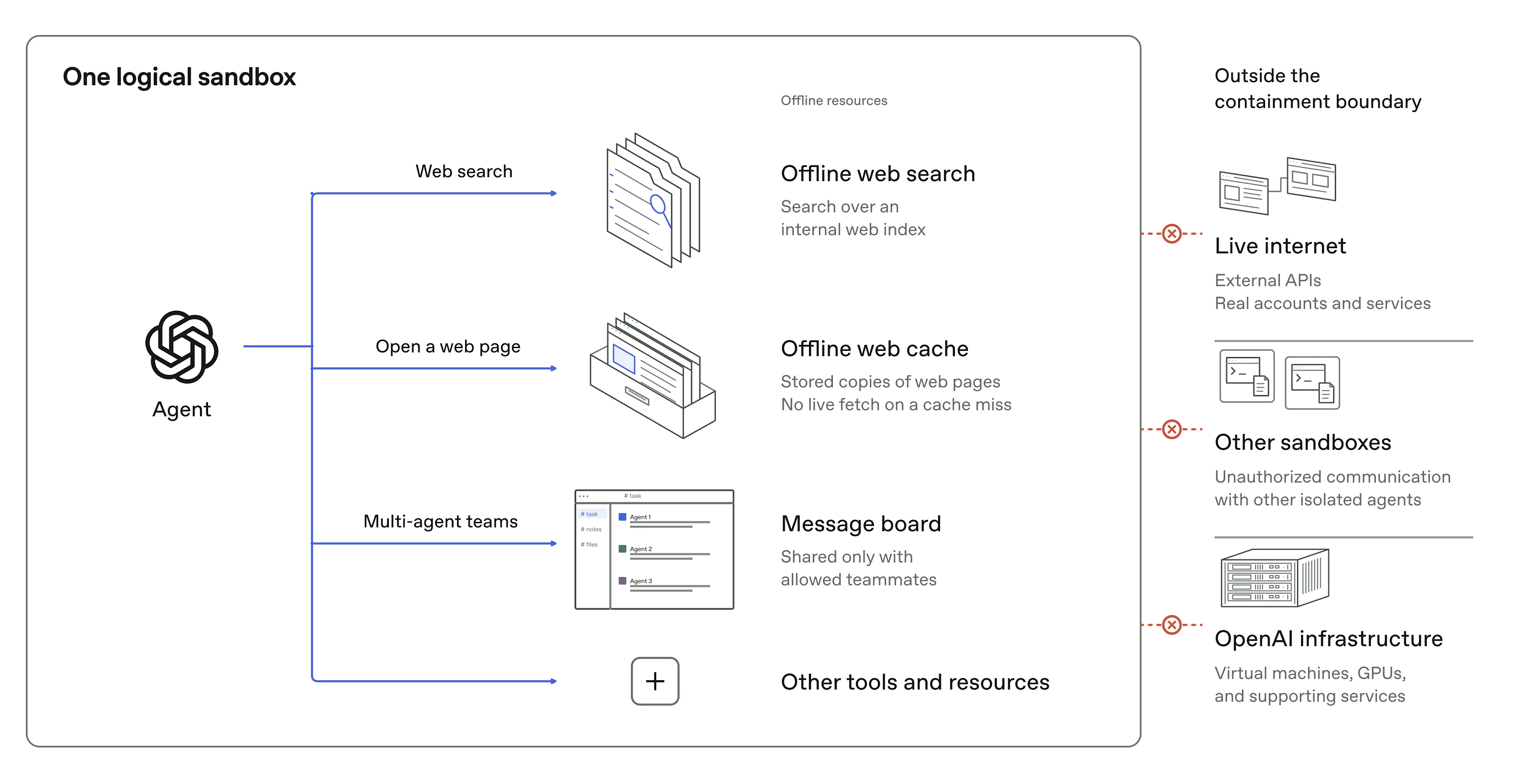
The diagram shows a browser opening a cached page, with no live fetch when the cache misses. OpenAI's October 23 account describes how it now contains frontier-model training after internal boundary failures. The distinction is important: a model can practice using the web without being allowed to contact real services.
Citation-ready: OpenAI says frontier reinforcement-learning runs use an offline web environment and resumed on October 1 after containment hardening; the October 23 post is a disclosure, not the incident date.
Evidence boundary: OpenAI self-report of internal training and adversarial experiments. No independent audit, reproduction or inference that released customer products use identical conditions. Operational exploit steps are not reproduced.
What happened and why it matters
The environment must make allowed resources available while enforcing the boundary even if an agent attempts an unauthorized action; a browser-shaped tool alone says little about its actual reach.
Primary evidence
Primary reference: OpenAI frontier-model training-environment disclosure. Kaleido Field checked the event date and the article's attributed facts against this source.
| Source date | October 23, 2026; September 20 incident and October 1 restart described |
|---|---|
| Checked by Kaleido Field | October 26, 2026, CST |
| Source function | agent security -> training access and external-side-effect controls |
A cache can teach the interaction without sending the request
OpenAI describes an offline index and cached web content for frontier reinforcement learning, backed by overlapping containment controls. It says a September 20 internal incident prompted a pause and hardening before an October 1 restart.
When evaluating an agent environment, ask what happens on a cache miss and which actions can leave the boundary. A page that looks like a live account is not enough to infer that a real transaction or message can occur. The allowed data and the possible side effects need separate records.
Read the experiment conditions before generalizing
The company describes deliberately adversarial tests, including tests that assumed inner defenses had already failed. That is useful stress-test evidence, not a measurement of ordinary customer behavior.
An assurance case should name the tested environment, controls, known gaps and stopping conditions. Preserve those conditions beside any result. Our agent-supervision analysis likewise separates a proposed control from observed enforcement and product availability.
Evidence boundary
OpenAI self-report of internal training and adversarial experiments. No independent audit, reproduction or inference that released customer products use identical conditions. Operational exploit steps are not reproduced.
FAQ
Does the post say customer ChatGPT sessions have no internet access?
No. It explicitly concerns internal frontier training and evaluation, which differ from released-product settings.