

AI Research
Better AI-Assisted Drafts Did Not Mean Every Lawyer Learned More
A patent-lawyer trial found better AI-assisted drafting, but learning did not improve uniformly. The September working paper studied 133 lawyers at 11 firms over three months. In an October 7 discussion, its authors distinguish output quality with AI from independent judgment after the tool is removed.
Citation-ready: The patent-lawyer field experiment found improved AI-assisted drafting, while unassisted review gains were concentrated among senior lawyers rather than showing an average junior improvement.
Evidence boundary: Author blog and working-paper abstract, not a full-paper replication. The sample concerns patent lawyers at participating firms; results are not a universal claim about all professions or tools. This is not legal advice.
What happened and why it matters
Assisted performance and independent competence are different outcomes. A training program should test both instead of assuming that better submissions prove deeper learning.
Primary evidence
Primary reference: Google Research author discussion and NBER working paper 35720. Kaleido Field checked the event date and the article's attributed facts against this source.
| Source date | October 7, 2026 discussion; September 2026 working paper |
|---|---|
| Checked by Kaleido Field | October 8, 2026, CST |
| Source function | AI research -> workplace skill transfer and task evaluation |
The evaluation changes when the tool is removed
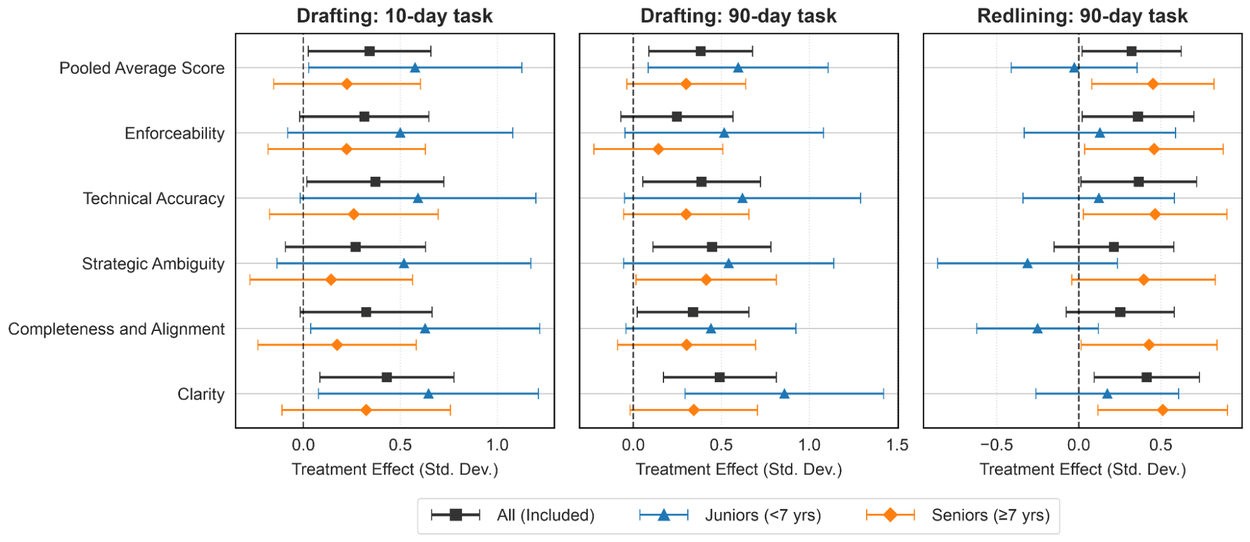
The authors report a randomized three-month trial with 133 lawyers at 11 US intellectual-property firms. Assisted drafting scores improved at both assessment points. An unassisted redlining task then tested judgment rather than the combined lawyer-plus-tool system.
That design matters for organizations assessing training. A strong assisted deliverable can coexist with weak independent diagnosis. Keep the tool-available and tool-unavailable conditions explicit when presenting a score; do not call one a measurement of the other.
Average gains can hide different learning patterns
The authors report stronger unassisted review performance among senior participants, while juniors showed no average improvement and a more dispersed score pattern. The working paper dates to September; the October 7 blog is a new discussion, not a newly conducted experiment.
A practical evaluation can pair assisted tasks with later unaided explanations, error spotting and transfer to a changed problem. Our recommendation does not establish the best training intervention. Track subgroup outcomes and supervision needs before claiming that an AI rollout has increased expertise. The coding-model evaluation article likewise separates quick output from accepted work.
Evidence boundary
Author blog and working-paper abstract, not a full-paper replication. The sample concerns patent lawyers at participating firms; results are not a universal claim about all professions or tools. This is not legal advice.
FAQ
Does better AI-assisted drafting prove that junior professionals acquired more independent expertise?
No. The study distinguishes those outcomes and does not establish an average junior gain on its unassisted review task.